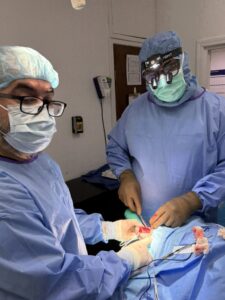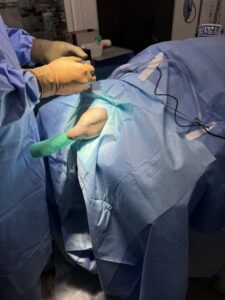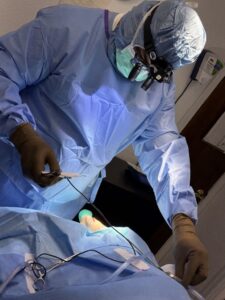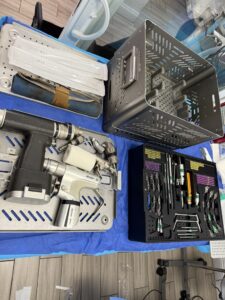
At H&M VetSurg, led by board-certified surgeon Hani M Korani DVM, DACVS-SA, we are committed to using the most advanced and safest materials for your pet’s surgery. When performing a TPLO (Tibial Plateau Leveling Osteotomy) to stabilize the knee after a Cranial Cruciate Ligament (CCL) tear, we exclusively utilize titanium alloy (Ti-6Al-4V) implants over traditional stainless steel. This choice is based on superior biology, mechanics, and long-term patient health.
Why Titanium Alloy (Ti-6Al-4V) is the Gold Standard
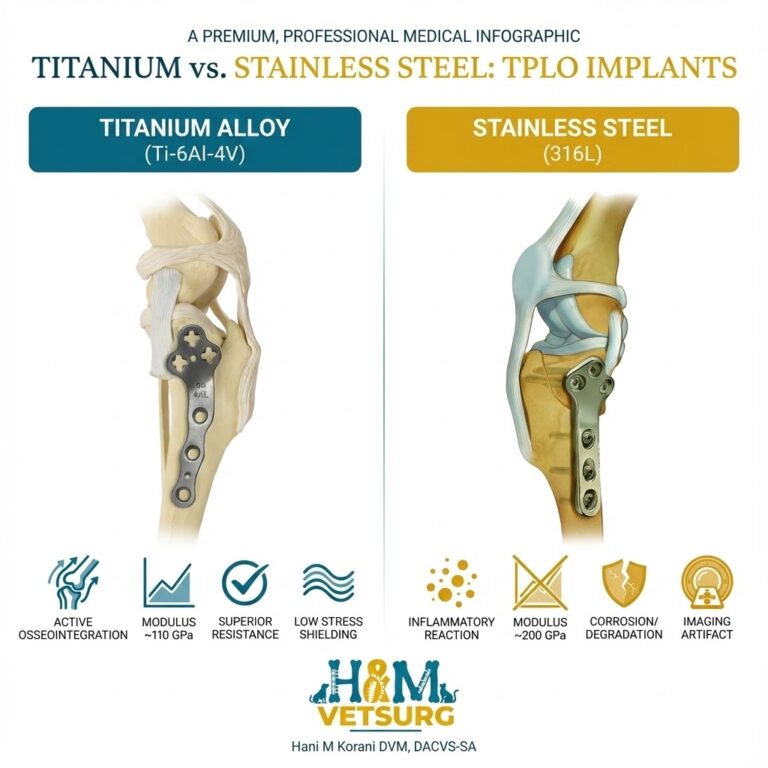
The decision to use titanium is driven by six critical factors that optimize healing and minimize complications compared to stainless steel (316L):
- Superior Biocompatibility & Reduced Ion Release
Titanium is highly biocompatible—it is chemically inert and does not readily react with body tissues. This minimizes the risk of localized inflammation or adverse reactions. Stainless steel, in contrast, can slowly release trace metal ions (like nickel and chromium) through corrosion. This ion release can occasionally trigger inflammatory responses, a risk minimized with titanium, which is non-reactive.
- Active Osseointegration
Titanium has the unique, bioactive ability to osseointegrate—bone cells can bond directly to its native oxide layer. This allows the implant to become physically incorporated into the skeletal structure, providing superior, long-term anchoring and stability that is vital for successful osteotomy site fusion. Stainless steel cannot achieve this direct bone bonding, as healing occurs only around the implant.
- Minimal Stress Shielding
The elastic modulus (stiffness) of titanium alloy around 110 GPa is much closer to that of cortical bone around 18 GPa than stainless steel around 200 GPa. This better mechanical match significantly reduces the effect of stress shielding, where a stiff implant prevents the underlying bone from receiving necessary mechanical load. By allowing the bone to bear an appropriate load, titanium promotes healthier long-term bone density and remodeling.
- Superior Corrosion Resistance and Durability
Titanium alloy is virtually immune to biological corrosion in the body, instantly forming a protective, inert titanium dioxide TiO2 layer. This corrosion resistance is critical for the long-term integrity of the implant, ensuring it maintains its mechanical strength and does not degrade over years of use, thus preventing inflammatory reactions from metal breakdown products
- Reduced Need for Implant Removal
Because titanium is so well tolerated and integrates with the bone, the risk of chronic, low-grade discomfort or swelling that sometimes requires the removal of stainless-steel implants is dramatically reduced. For the patient, this usually means a single, successful surgery and avoids the risk and cost associated with a second procedure.
- Better Imaging Clarity (MRI/CT)
Stainless steel causes significant artifact (distortion/shadowing) on advanced imaging like MRI and CT scans. Titanium causes far less artifact, which is essential for obtaining clear postoperative images to accurately monitor soft tissues (like the menisci) and assess the degree of bone healing adjacent to the implant.
🔬 The Proof: Elaboration on Scientific and Clinical Evidence
Our material choice is affirmed by research focusing on both implant survival and long-term patient health:
- Resistance to Biofilm and Infection: Implant-associated infection is a major complication in orthopedics. Evidence indicates that titanium’s surface properties make it less hospitable for bacterial attachment and biofilm formation. Studies comparing biofilm growth have found that the surface density of viable cells within biofilms can be significantly higher on stainless steel than on titanium wires, suggesting titanium’s better bacterial resistance contributes to the lower rate of clinical infections reported.
- Biomechanical Equivalence and Safety: While studies comparing titanium versus stainless steel TPLO implants sometimes show no statistical difference in overall major complication rates, the biomechanical rationale remains strong. Titanium’s high fatigue strength combined with its more advantageous elastic modulus ensures the implant is strong enough for fixation while mitigating the long-term risk of stress shielding—a risk that may not manifest in short-term complication reports but is critical for lifelong orthopedic health.
- Human Orthopedic Gold Standard: The wide adoption of titanium in demanding human procedures—including total hip and knee joint replacements, where implants must last for decades under high-cyclic loading—serves as a compelling clinical benchmark. The industry’s consensus on titanium’s reliability and superior biological integration for these permanent, high-load applications validates its use in canine TPLO.
Our Commitment to Your Pet’s Care
As Hani M Korani DVM, DACVS-SA, a board-certified veterinary surgeon with H&M VetSurg, I choose titanium alloy for TPLO procedures because it represents the pinnacle of implant technology. This material choice—which combines high stability, superior healing properties, and long-term biological inertness—ensures the fastest, most stable healing and provides the best possible long-term mobility and comfort for your dog.
If you have any questions about TPLO, the materials we use, or the surgical process, please call us at 415-853-7600. You can also learn more about our mobile surgical service at hmvetsurg.com.